02 Jul. 2013

Kurna Hora

Ek is amper op die einde van my stories oor die Tjeggiese Republiek. Vandag gaan ek julle vertel van die dorpie Kutna Hora, en die effense grieselrige rede waarom ons soontoe is.
Sien, die aantrekkingkrag van Kutna Hora, is die Sedlec Ossuary, of te wel die Beendere Kerk.

I am coming to the end of my strories about the Czech Republic. Today I am going to tell you about the little town, Kutna Hora, and the somewhat gory reason we went there. 
You see, the claim to fame of Kutna Hora, is the Sedlec Ossuary, or if you will, the Bone Church.


Van buite af 'n doodgewone kerkie, met 'n kerhof knus daarom.
From the outside, a ordinary small church, hugged by a cemetery. 


Maar binne lyk dinge so bietjie minder gewoon.
But on the inside, a little less ordinary.

Die storie begin in 1278, toe Henry, die hoof van die Sistersiaanse klooster in Sedlec deur die Koning van Bohemia, Koning Otakar II. Henry het teruggekom met 'n bietjie grond wat hy op Golgotha bymegaar gevee het, en dit oor die begrafplaas gespinkel. Berigte daarvan het gou dwardeur Sentraal Europa versprei, en die begrafplaas in Sedlec het 'n gesogte laaste rusplek geword.
In die middel van die 14de eeu, gedurende die Swart Dood, en na die Hussiete Oorlog vroeg in die 15de eeu, is derduisende in die klooster begrafplaas begrawe, en dit moes baie vergroot word.
Rodom 1400 is 'n Gotiese kerk in die middel van die begrafplaas gebou met 'n gewelfde boonste vlak, en 'n laer deel wat gebruik sou word as 'n beenkerker vir die massagrafte wat gedurende die werkery opgegrawe is, en as spasie vir nuwe grafte.
In 1511 is die taak van opgrawery oorgedra aan 'n hlaf-blinde monnik.
Tussen1703 en 1710 is daar 'n nuwe ingang gebou om die  voorste muur wat skuins gele het te stut, en die boonste kerk is herbou. Dit is deur Jan Santini Aichel ontwerp in die Tjeggiese Barok styl.
In 1870 is  František Rint, 'n houtkerwer deur die Schwartenberg familie aangestel om die hope bene te orden. František, klaarblyklik met net die hulp van sy vrou en kinders, het met groot toewyding en moeite elkeen van die 40 000 menslike beendere skoongemaak en gebleik, om daarmee sy makabere kunswerke te skep.


The story begins in 1278, when Henry, the abbot of the Cistercian monastery in Sedlec, was sent to the Holy Land by King Otakar II of Bohemia. He returned with him a small amount of earth he had removed from Golgotha and sprinkled it over the abbey cemetery. The word of this pious act soon spread and the cemetery in Sedlec became a desirable burial site throughout Central Europe.
In the mid 14th century, during the Black Death, and after the Hussite Wars in the early 15th century, many thousands were buried in the abbey cemetery, so it had to be greatly enlarged.
Around 1400, a Gothic church was built in the center of the cemetery with a vaulted upper level and a lower chapel to be used as an ossuary for the mass graves unearthed during construction, or simply slated for demolition to make room for new burials.
After 1511, the task of exhuming skeletons and stacking their bones in the chapel was given to a half-blind monk of the order.
Between 1703 and 1710, a new entrance was constructed to support the front wall, which was leaning outward, and the upper chapel was rebuilt. This work, in the Czech Baroque style, was designed by Jan Santini Aichel.
In 1870, František Rint, a woodcarver, was employed by the Schwarzenberg family to put the bone heaps into order. Painstakingly, he (apparantly with only the help of his wife and children) cleaned and bleached every one of the 40 000 bones he crafted into his macabre works of art. See for yourself:


Hierdie is maar 'n paar van die foto's wat ons geneem het. Kan julle nou verstaan wat ek bedoel met makabere kuns?

These are just a few of the pictures we've taken. Do you understand now what I mean by macabre art?


Hier is 'n blik op die kerkhof. Mooi, nê?
A glimpse of the cemetery. Isn't it pretty?

 Die Sedlec Katedraal of te wel "The Cathedral of Assumption of Our Lady and Saint John the Baptist" is net 'n klipgooi van die Beenkerk af. Vir my was dit een van die mooiste katedrale- minder opgesmuk as baie ander, maar steeds 'n glorieryke en baie imposante voorbeeld van  barok styl.

The Sedlec Cathedral, or The Cathedral of Assumption of Our Lady and Saint John the Baptist is just a stone through away from the Bone Church. I find it one of the most beautiful cathedrals- less ornate, but still graceful, and a very imposing example of Baroque architecture.

The Cathedral of Assumption of Our Lady and Saint John the Baptist


Ingang na die Katedraal

Entrance to the cathedral


Ongelooflike houtwerk

Wonderful carpentery


 Die pragtigste wenteltrap

A beautiful spiral staircase


 En hulle eie geraamte in die (glas) kas. Die oorblyfsels van twee martelaars St Felix en St Vincent in glaskaste is in 1742 deur Pous Benedict XIV aan die katedraal geskenk. Nou dit was vir my grillerig! Die geraamtes, ten volle geklee, het was gesigte.


The reliquaries holding Saint Felix’s and Saint Vincent’s relics were donated by Pope Benedict XIV in 1742. These fully clothed sceletons have wax faces. Now this I found creepy!


Die prentjie mooi Kutna Hora was vir my 'n verrassing. 

The picturesque town of Kutna Hora was a surprise. 


Blommetjies in vensters 

Flowers on windowsills


Geheime tuine

Secret gardens


The Italian Court


 Kipstraatjies

Cobbled Streets


 En baie baie ou geboue.

And very very old buildings.


 'n Betowerende klein teekamer
A charming tea room


'n Restaurant genaamd U Šneka pohodáře wat beteken "Die tevrede Slak"

A Restaurant named U Šneka pohodáře which means "The Contented Snail"


 Die uitsig uit ons hotelkamer. Ons het in Hotel Kréta gebly- 'n nederige, maar skoon en gerieflike hotel, met baie redelike tariewe, en hartlike kos. 

The View from our Hotel room. We stayed in Hotel Kréta- a humble, but clean and comfortable place, with reasonable prices and wholesome food.


Kutna Hora was 'n onverwagte juweel, en ek is jammer ons het so 'n kort rukkie gehad om daar te spandeer. Maar wie weet, miskien eendag weer...

Kutna Hora was an unexpected jewel, and I am sorry that we couldn't stay a bit longer. But who knows, perhaps there is another chance...

28 Jun. 2013

Vyšehrad


Vyšehrad is 'n geskiedkundige fort in Praag. Dis waarskunlik al in die 10de eeu gebou, op 'n heuwel wat oor die Vltava Rivier uitkyk. Die Basilica of St Peter and St Paul en die Vyšehrad Begrafplaas, waar bekendes soos komponiste Bedřich Smetana en Antonín Dvořák te ruste gele is, is op die gronde gelee. Die oudste staande gebou in Praag, die Rotunda van St Martin wat uit die 11de eeu dateer, is ook daar te vinde.
Daar word beweer dat Vyšehrad die plek was waar die eerste nedersetting begin het wat later Praag sou word, maar dit is nog onbeverstig.
Ons het Vyšehrad op 'n Sondag besoek- dis vreedsaam en stil, met groot groen parke om die geboue. Die begrafplaas is goed versorg, en terwyl ons daar was, was daar mense wat besig was om die laaste rusplekke van geliefdes skoon te maak, en te verfraai.

Vyšehrad is a historical fort located in the city of Prague. It was probably built in the 10th century, on a hill over the Vltava River. Situated within the castle is the Basilica of St Peter and St Paul, as well as the Vyšehrad Cemetery, containing the remains of many famous people from Czech history, among them Antonín Dvořák en Bedřich Smetanach. It also contains Prague's oldest surviving building, the Rotunda of St Martin from the 11th century.
Local legend holds that Vyšehrad was the location of the first settlement which later became Prague, though thus far this claim remains unsubstantiated.
 We visited Vyšehrad on a Sunday. It is so peaceful and quiet, with green parks surrounding the buildings. The cemetery is well cared for, and while we were there, there were some people tending the graves of love ones.


Basilica of St Peter and St Paul


 Die beskilderde binnekant

The painted interior

'n Pragtige venster

A beautiful window


 Mosaik bokant 'n deur

Mosaik  above a door


Twee van die deure

Two of the doors


'n Hek wat na die begrafplaas lei

A gate leading to the cemetery


Van die grafte onder dak

Some graves under a roof


Twee grafte wat vir my mooi was

Two graves I loved


Komponis Dvorak se graf

Composer Dvorak's grave


'n Engel op die begrafplaasmuur

An Angel on the cemtery wall


 Rotunda van St Martin

Rotunda of St Martin 


En 'n laaste blik op Praag, vanaf  Vyšehrad

And a last glimpse of Prague from Vyšehrad

19 Jun. 2013

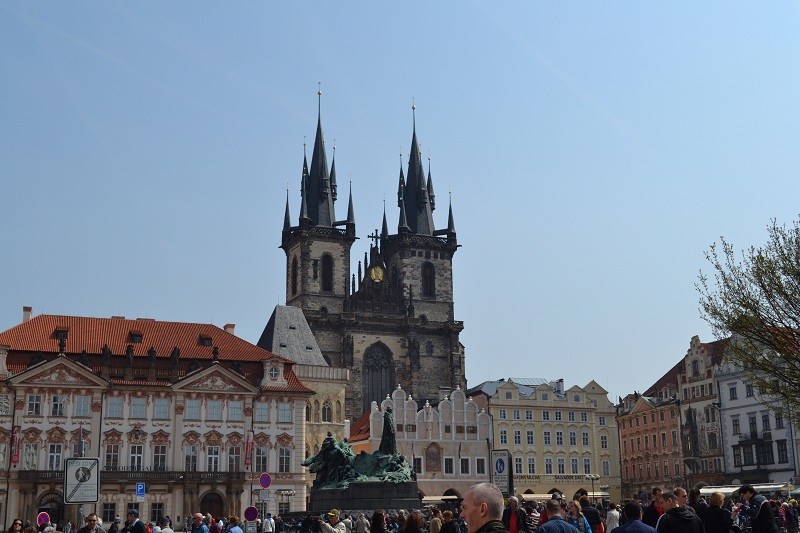
Ou Dorp-Praag/ Old Town-Prague

 Vandag sit ek heerlik in die sonnetjie, in my eie huis, met die katte en 'n pot tee hier by my. Dis so lekker om by die huis te wees, al het ek 'n stukkie van my hart in die Tjeggiese Republiek gelos. Uiteindelik kan ek die inskrywings wat ek al in Praag gedoen het, klaarmaak. So 'n inskrywing neem maar tyd, want die foto's moet gekrimp word om minder rekenaarspasie te neem, en om vinniger opgelaai te word, en ek voeg graag skakels by vir my lesers wat meer wil lees. Dan is daar nog taal en spelling... Maar kom ek hou op klets en vertel julle:

Ou Dorp, Praag

Die ou dorp is in die hartjie van Praag, en het sy ontstaan in die 9de eeu gehad. Rekords dui aan dat daar al vanaf die 1100's op Saterdae markte gehou is, en groot millitêre byeenkomste is ook daar gehou. In die begin is dit deur 'n halfsirkel moot en muur wat gegrens het aan die Vltava rivier van die buitewereld afgesonder, maar met die onstaan van die Nuwe Dorp in die 14de eeu, is dit opgebreek.

I am doing this post in a splash of golden sunshine, in my own home. Around me the cats are soaking up some son, and I have a pot of tea at my elbow. It's so good to be back- though I left a piece of my heart behind in the Czech Republic.  I wrote this post in Prague, but I still had to add some finishing touches- shrinking the pictures, adding the links and checking spelling and grammar. But enough said about that, let me tell you about

Old Town Prague


From its early existence, around 9th century, Old Town was laid out of settlements which appeared from the spacious marketplace on the bank of Vltava. Records dating back to 1100AD indicate that every Saturday a market was held on the marketplace, and large military gatherings also took place there. It was separated from the outside by a semi-circular moat and wall, connected to the Vltava at both of its ends. After the city was expanded in the 14th century by Charles IV with the founding of the New Town, the moat and wall were dismantled soon after.


 Elke uur is daar 'n samedromming van mense op die plein wat hulle vergaap aan skouspel van die astronomiese horlosie wat die uur met groot fanfare aankondig. Eers lui 'n geraamte, of te wel, die dood 'n klokkie, en dan verskyn uitbeeldings van die twaalf Apostels een na die ander in die venstertjies bokant die horlosie. Die horlosie slaan, en iemand in middelseeuse klere blaas 'n beul bo-op die toring.
 Die indrukwekkende horlosie is in 1410 geïnstalleer. Dis die derde oudste astrononmiese horlosie in die wereld, en dis oudste een wat steeds werk. 
Die werking van die horlosie is te ingewikkeld vir my om te verduidelik (of te verstaan) maar as jy meer daaroor wil weet, gaan lees hier. Om die uurlikse vertoning te sien, gaan kyk hier.

Every hour, on the hour, masses gather on the town square, to watch the clock. The Prague Astronomical Clock is a medieval astronomical clock mounted on the South facing wall of the city hall, situated on the Old Town Square. The clock was first installed in 1410, making it the third-oldest astronomical clock in the world and the oldest one still working. 
The clock mechanism itself is composed of three main components: the astronomical dial, representing the position of the sun and moon in the sky and displaying various astronomical details; "The Walk of the Apostles", a clockwork hourly show of figures of the Apostles and other moving sculptures—notably a figure of Death (represented by a skeleton) striking the time; and a calendar dial with medallions representing the months.

The mechanics of this clock is too complicated for me to try to explain- if you are interested to know how it works, have a look here, and here if you want to watch the hourly spectacle.


Op baie van die geboue pryk simbole van die families wat daar gewoon het.   Hier het drie families van vioolmakers gewoon:

On a lot of the old buildings symbols gave an indication of the families who lived there. In this building lived three families of violin-makers:


Jou adres was dan iets soos "At the golden ring",

Your adress then was something like "At the golden Ring",

 Of "At the golden snake"

Or "At the golden snake"


of "At the stone bird"

or "At the stone bird"


En hier sou ons gebly het!

This is where we would have lived!

 "By die befoeterde beer"

"At the grumpy bear"


Hierdie is 'n Gotiese venster wat oorgebly het van die oudste universiteit in sentraal Europa, Charles Universiteit, wat deur Karl IV begin is. Die Veertiende-eeuse gebou is in 1945 deur die Duitsers vernietig.


 Charles University was the first university in Central Europe, founded by Emperor Karl IV. Unfortunately, the original XIV century building was destroyed by the Germans in 1945, and only the gothic window has survived.  


"Die spook van Don Giovanni" buite die ingang van die Estate Teater.   Die Opera "Don Giovanni"  het in 1787 hier geopen, en is deur Mozart self gederigeer.


The statue of the ghost of Don Giovanni to the left of the Estate Theatre entrance. This theatre premiered the famous Opera, Don Giovanni, conducted by none other than W.A.Mozart himself in 1787.


"Powder Tower' was een van die ingange na die stad in die 15de eeu. Die naam dateer uit die 17de eeu toe die toring as stoorplek vir buskryt gebruik is.

Powder Tower was one of the several entrances to the city in 15th century. Origins of its name date back to the 17th century when the tower was used to store gun powder.


Dis dan my storie oor die Ou Dorp. Natuurlik kan ek nie alles vertel nie. Maak nie saak watter woorde ek kies, of watter foto's ek wys nie, niks kan die werklike karakter vasvang nie. As ek 'n horlosie hoor slaan, maak ek my oë toe, en word teruggevoer na vreemde stemme, musiek, perdepote op kilpstrate, en geure van koffie en kaneel. 

Try as I might, I will never be able to capture the essence of the golden city. But when a clock strikes the hour, I close my eyes, and I can hear the forreign voices, the music, the clippety clop of horsesfeet  on cobbled  streets, and the aroma's of coffee and cinemon.